
BOOKS

Svitlana Biedarieva, Ambicoloniality and War: The Ukrainian-Russian Case (Palgrave Macmillan, 2025).
This book proposes a new notion of “ambicoloniality” to speak about the current situation when Ukraine has become Russia’s territory of obsession, and Russia, in its desire to occupy Ukraine, has in effect subjected itself to Ukraine’s symbolic dominance.
Ambicoloniality presents a key point of divergence from already existing models, as the mutual impact of the two countries over centuries has gone both ways, over a shared border — in contrast to other empires that established their colonial power relations at a distance. The Ukrainian-Russian case is very different from the examples covered by both postcolonial and decolonial theorists. To explore the reasons and consequences of such a differing process of colonial expansion/ anti-colonial struggle/decolonial release, the book inquires into the historical and cultural reasons for the emerging gap between the two states. It explores which role cultural hybridity plays in political self-identification in both Ukraine and Russia, and how this hybridity has manifested in society and culture (including examples of art and literature) following the dissolution of the Soviet Union in 1991, until 2023.
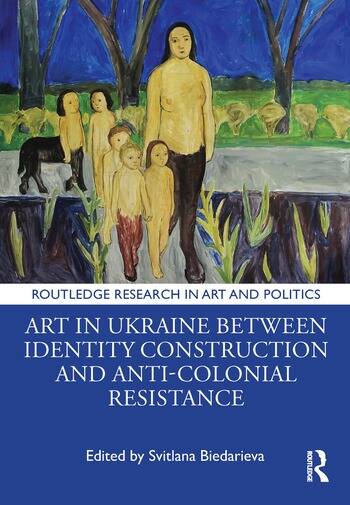
Svitlana Biedarieva, ed. Art in Ukraine between Identity Construction and Anti-Colonial Resistance, Routledge, 2024. Contributors: Ksenia Nouril, Asia Bazdyrieva, Jessica Zychowicz, Alisa Lozhkina, Ewa Sułek, Oleksandra Osadcha, Kateryna Filyuk, Illia Levchenko, Kateryna Botanova, and Svitlana Biedarieva.
This edited volume traces the development of art practices in Ukraine from the 2004 Orange Revolution, through the 2013–14 Revolution of Dignity, to the ongoing Russian war of aggression.
Contributors explore how transformations of identity, the emergence of participatory democracy, relevant changes to cultural institutions, and the realization of the necessity of decolonial release have influenced the focus and themes of contemporary art practices in Ukraine. Chapters analyze such important topics as the postcolonial retrieval of the past, the deconstruction of post-Soviet visualities, representations of violence and atrocities in the ongoing Russian war against Ukraine, and the notion of art as a mechanism of civic resistance and identity-building.
The book will be of interest to scholars of art history, Eastern European studies, cultural studies, decolonial studies, and postcolonial studies.

This volume focuses on political and social expressions in contemporary art of Ukraine, Estonia, Lithuania, and Latvia. It explores the transformations that art in Ukraine and the Baltic states has undergone since their independence in 1991, discussing how the conflicts and challenges of the last three decades have impacted the reconsideration of identity and fostered resistance of culture against economic and political crises. It analyzes connections between the past and the present as seen by the artists in these countries and looks at their visions of the future.
Contemporary Ukrainian art portrays various perspectives, addressing issues from controversial historical topics to the present military conflict in the east of the country. Baltic art speaks out against the erasure of past historical traumas and analyzes the pertinence of its cultural scene to the European community. The contributions in this collection open a discussion of whether there is a single paradigm that describes the contemporary processes of art production in Ukraine and the Baltic countries.
With contributions by Ieva Astahovska, Svitlana Biedarieva, Kateryna Botanova, Olena Martynyuk, Vytautas Michelkevičius, Lina Michelkevičė, Margaret Tali, and Jessica Zychowicz.
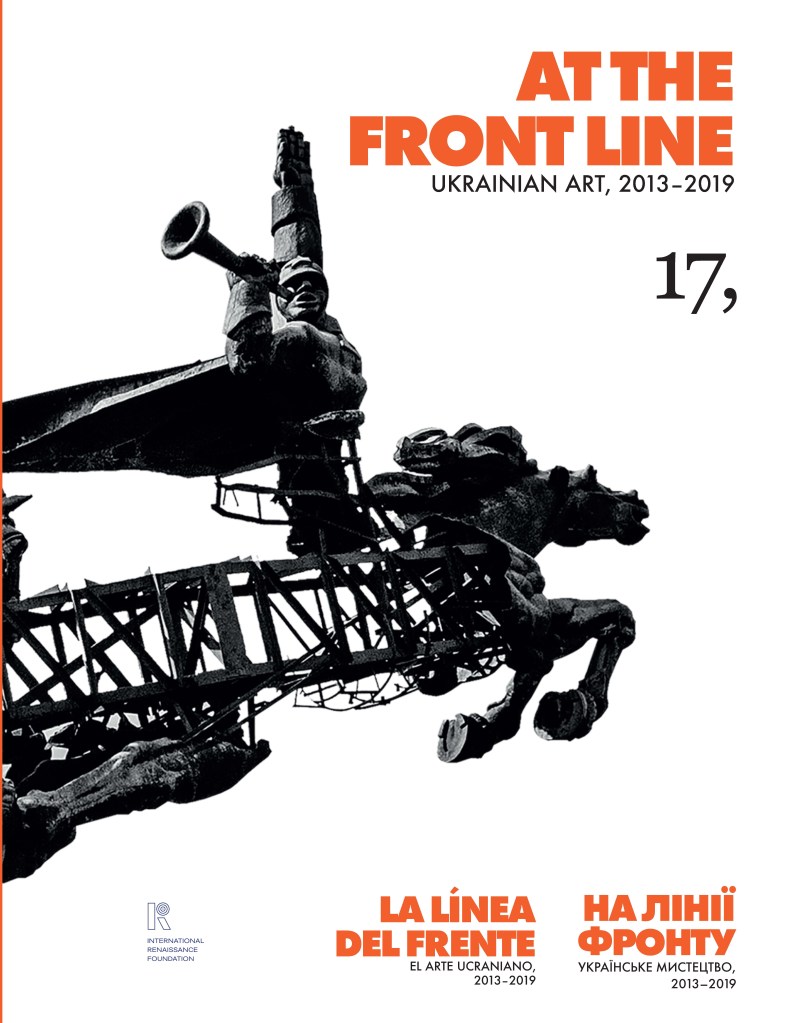
Svitlana Biedarieva and Hanna Deikun, eds., At the Front Line: Ukrainian Art, 2013–2019/ La línea del frente. El arte ucraniano, 2013–2019/ Na linii frontu.
Ukrains’ke mystetstvo, 2013–2019, Mexico City and Kyiv: Editorial 17 and International “Renaissance” Foundation, 2020.
The catalog of the exhibition “At the Front Line. Ukrainian Art, 2013-2019” speaks about the turbulent political and social situation in Ukraine of the last seven years, including such events as the Revolution of Dignity, the annexation of Crimea, and the war with Russia. It focuses on the materials of 13 Ukrainian artists’ exhibition at the National Museum of Cultures in Mexico City from September 2019 to February 2020. This exhibition was part of a larger interdisciplinary project realized in Mexico City that also included a series of panel discussions with the participation of Ukrainian, Mexican, and British researchers and artists at the Museum of Memory and Tolerance and eight documentary screenings at the National Cinematheque. This trilingual publication (English-Spanish-Ukrainian) documents the first large-scale project in Latin America which looked at the contemporary Ukrainian art scene and the situation in the country. The exhibition was further presented at the “Oseredok” Ukrainian Cultural and Educational Centre in Winnipeg, Canada. Participating artists: Piotr Armianovski, Yevgenia Belorusets, Svitlana Biedarieva, Zhanna Kadyrova, Yuri Koval, Roman Mikhaylov, Roman Minin, Olia Mykhailiuk, Lada Nakonechna, Yevgen Nikiforov, Kristina Norman, Mykola Ridnyi, Anton Popernyak, and works from the collection of the Izolyatsia Platform for Cultural Initiatives (Daniel Buren, Leandro Erlich, and Pascale Marthine Tayou), César Martínez Silva, and Paola Paz Yee. Texts by Yevgenia Belorusets, Svitlana Biedarieva, Uilleam Blacker, Hanna Deikun, Oleksandra Gaidai, Olesya Khromeychuk, Ricardo Macias Cardoso, César Martínez Silva, Jean Meyer, Olia Mykhailiuk, Maryna Rabinovych, Vsevolod Samokhvalov, Paola Paz Yee, and Mykola Ridnyi.
SELECTED BOOK CHAPTERS AND ARTICLES
“Decolonization and disentanglement in Ukrainian art,” in Kateryna Botanova, ed., Reclaiming History: Decoloniality and Art in Ukraine after 1991, Kyiv: Publish Pro and PinchukArtCenter, 2025, 94–107.
“Oleksandr Roytburd,” “Ukrainian New Wave,” and “Pavlo Makov,” articles for Grove Art Online, Oxford University Press, Feb. –May 2025.
“Open Group’s Repeat after Me II: Echoing the war,” in Marta Czyż, ed., Repeat after Me II. Catalogue of the Polish Pavilion at the 60th Venice Biennale, Warsaw: Zachęta National Gallery, 2024.
“Unfolding coloniality: Ecocide as the erasure of memory,” in Adrian Ivakhiv, ed., Terra Invicta: Ukrainian Wartime Reimaginings for a Habitable Earth, Montreal: McGill-Queen’s University Press, 2025.
“The decolonized body: Corporeality, violence, and objectification in recent Ukrainian art,” in Natasha Klimenko, Viktoria Sereda, and Miglė Bareikytė, eds., Images and Objects of the Russo-Ukraine War, Berlin: Forum Transregionale Studien, 2025 (Accepted, preparing for publication)
“From the postcolonial condition to the decolonial option,” in Ukrainian Decolonial Glossary, Yuliia Elyas, Anastasiia Omelianiuk, and Iva Naidenko, eds., 2024.
“Ukrainische Künstler: innen im Widerstand gegen die großangelegte Invasion: Dekolonialisierung in der Kunst nach dem 24. Februar 2022,” Ukraine-Analysen, No. 293 (18 Jan. 2024).
“Dekolonizacja i wyzwolenie w sztuce ukraińskiej,” Konteksty: Polska Sztuka Ludowa, No. 343 (4), 2023, 37–41.
“Westplaining Ukraine: Lost in translation,” WunderKombināts. Latvian Art Yearbook, No. 2 (Nov. 2023).
“The Morphology of War,” Daedalus. Journal of the American Academy of Arts and Sciences (MIT Press), Vol. 152 (Spring 2023), 23–24.
“Ways to Murder with a Flag: Paradoxical discourse and subversive affirmation in the art of Odesa conceptualists,” in Maia Toteva, Tom Williams, and Gediminas Gasparavičius, eds., Walking with the Enemy: Reclaiming the Language of Power and Manipulation in the Post-Truth Era, Manchester: Manchester University Press, 2023. (Accepted, preparing for publication)
“The Morphology of War: Against neo-colonial narcissism,” in Tanel Randel, ed., Hüvasti, Ida! Hüvasti, Narcissus!/ Goodbye, East! Goodbye, Narcissus!, Tallinn: EKKM, 2023, 95–99.
“Ukrainian wartime art: Anti-colonial resistance in a decolonial age,” Immediations, No. 19 (2022), 34– 38.
“Decolonizing Ukrainian art history in research and teaching,” ASEEES NewsNet, Vol. 62, No. 6 (November 2022), 3–5.
“Decolonization and disentanglement in Ukrainian art,” post at MoMA, 2 June 2022. Available online at https://post.moma.org/decolonization-and-disentanglement-in-ukrainian-art/.
“Art communities at risk: On Ukraine,” October, Vol. 179 (Winter 2022) (MIT Press),137–149.
“Women’s history as the history of dispossession in contemporary Ukrainian art,” in Jessica Zychowicz, ed., Freedom Taking Place: War, Women and Culture at the Intersection of Ukraine, Poland, and Belarus, London: Vernon Press, 2023, 23–36.
“On the concept of the Museum of Contemporary Art in Ukraine,” Art Margins Online (MIT Press), 11 Nov. 2021.
“The documentary turn in new Ukrainian art,” in Svitlana Biedarieva, ed., Contemporary Ukrainian and Baltic Art: Political and Social Perspectives, 1991–2021, Stuttgart: ibidem Press, 2021, 53–78.
“The face of the conflict: Ukrainian artists at the frontline,” in Svitlana Biedarieva and Hanna Deikun, eds., At the Front Line: Ukrainian Art, 2013–2019/La línea del frente. El arte ucraniano, 2013–2019/Na linii frontu. Ukrains’ke mystetstvo, 2013–2019, exh. cat., Mexico City and Kyiv: International “Renaissance” Foundation, 2020, 12–15.
“El cuerpo barroco. El exceso y el vacío en el performance contemporáneo” (“The baroque body: Excess and void in the contemporary performance”), in Francisco López, ed., Primer Concurso de Teoría de Performance/ Cuerpo, Mexico City: Secretariat of Culture, the National Centre of Arts ofMexico, and PerfoRedMx, 2020.
“Cuauhtémoc Medina. Portrait of the curator of the 12th Shanghai Biennale,” Critique d´Art. The International Review of Contemporary Art Criticism (University of Rennes 2), No. 52, Spring/Summer 2019, 90–93.
“Mexico 1968 – Beginning of the age of discrepancies: Interview with Cuauhtémoc Medina about Mexico ‘68,” Art Margins Online (MIT Press), 30 April 2018.
“The street artist as translator,” Space and Culture (SAGE Publishing), Vol. 19, No.1, February 2016, 4–14.
Selected op-eds and press articles
“Institutional transformation and cultural decolonization in Ukraine”, Kennan Institute, Woodrow Wilson International Center for Scholars blog, 16 August 2023.
“Mexican politics of representation regarding the war in Ukraine: A possibility of dialogue through culture:, Mexico Institute, Woodrow Wilson International Center for Scholars blog, 24 May 2023.
“post presents: Art, resistance, and new narratives in response to the war in Ukraine, with Inga Lace, Svitlana Biedarieva, Nikita Kadan, Lesia Khomenko and Ewa Sułek”, post at MoMA, 26 April 2023.
“Bowl of shadows. Danuta Kril preserves Ukraine’s smoked-ceramic craft”, Disegno. The Journal of Design, No. 35 (Spring 2023), 80.
“Alevtina Kakhidze”, Burlington Contemporary, 27 July 2022.
“Magical universes of Maria Prymachenko“, Flash Art, Czech/ Slovak edition, No. 65 (Oct. – Nov. 2022), 18-21.
“The Ukrainian artists making work as acts of resistance,” Financial Times, 28 March 2022
“Art under attack: Three decades of Ukrainian resistance,” Contemporary Art Stavanger, 24 March 2022.
“Лінія фронту: між Мексикою та Канадою“, Prostory. 13 вересня 2020.
“Crimea’s amazing history told through art“, Hyperallergic, 3 May 2019.
“Political art exhibitions in Ukraine face attacks and censorship“, Hyperallergic, 7 March 2019.
“Xavier Le Roy at the Jumex Museum” (in Spanish), La Tempestad, No. 140, November 2018.
“The devaluation of the human: Victor Man at Tamayo” (in Spanish), Revista
Código, 5 July 2018.
“To inhabit the Modernism: Leonor Antunes in Mexico” (in Spanish), Revista Código, 12 June 2018.
“Mexico: Reactive painting” (in Spanish), Revista Código, 29 May 2018.
“The importance of Havana’s first alternative biennial for the Cuban art scene“, Hyperallergic, 25 May 2018.
“Mario Pani: Architecture in process” (in Spanish), Revista Código, No. 96, Dec–Jan 2016/2017.
“Isaac Julien, Playtime/ Kapital: Are we all capitalists?” (in Spanish), Revista Código, 27 Sep 2016.
“Fragile modernity: Brazilian art at the MUNAL” (in Spanish), La Tempestad, 4 Aug 2016.
“Breaking the ice: Moscow art, 1960–80s”, London Student, Issue 7, Jan 2013.
“Giuseppe Penone: Spazio di Luce”, Courtauld Reviews, Issue 12, Nov 2012.
 Svitlana Biedarieva